NEON BREACH and BLACK ICE proved the harness could change a 3D shooter. But that might only mean the checks happened to fit shooters. The real test is another genre: Sundown Circuit and SUNSET DISTRICT.
Four builds
- NEON BREACH: no skill, pure API, five waves and a three-phase boss.
- BLACK ICE: harnessed, 8/8 gates, 318 KB, 163 draw calls.
- Sundown Circuit: no skill, 3 laps, 860m, 6 karts.
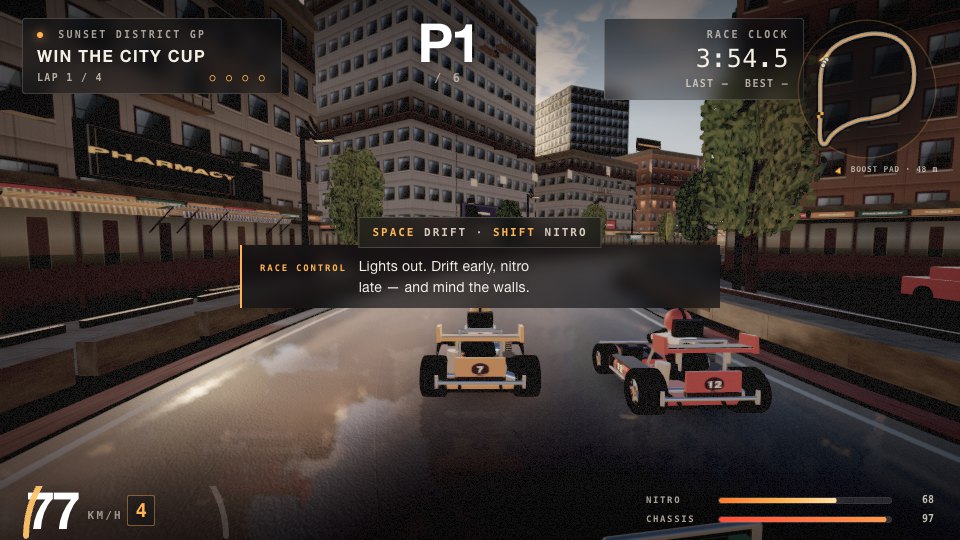
- SUNSET DISTRICT: same skill/harness, 4 laps, 5 rivals, 636 draw calls, 539,883 triangles, 4 lights.
They are not a controlled model benchmark: the scenes, budgets and design goals differ. They are evidence for whether the harness still works after a genre change.
What transfers
- Shader / page errors: every WebGL game must compile and start.
- Object census: both genres need to know what is in the scene and whether near props have identity.
- Light anchors: every light needs a physical source, not a screenshot-only light.
- Product shell: title, settings, pause, results, persistence and mobile — genre-independent.
- Mobile: 390×844 with no overflow and usable touch; both genres need it.
- Performance budget: draw calls, triangles and lights have different limits, but the idea of a limit transfers.
What must be rewritten
The first things to fail are collision and the definition of the loop.
The shooter collision gate assumes a walkable rectangular set, cargo coordinates and ray occlusion. A racing world is a continuous corridor with 204 barrier colliders; the player must be pushed back onto the track, not allowed to walk through buildings. The old collision contract has to be re-expressed as barrier push / wall clamp / track containment / progress checks.
The loop changes too. An FPS objective is “clear this wave / kill the boss”; a race is “hold a podium for four laps / beat the clock / finish with a chassis”. The product gate still applies, but success and failure conditions must be rewritten.
Input is the same story. Mouse aim plus WASD does not transfer to a kart. You need throttle, brake, steering, drift charge and nitro, plus a touch layout with separate steering zones. A gate can check that touch exists; it cannot design a good touch scheme.
Numbers
Black Ice passed 8/8 gates at 318 KB, 163 draw calls, 127k triangles and 12 lights. SUNSET DISTRICT passed 31/31 playtest checks at 636 draw calls, 539,883 triangles, 4 lights and a 390×844 mobile run.
These numbers are not a ranking. They show that one harness can produce checkable delivery conditions in two genres, while the budgets and failure modes remain different.
What it doesn't prove
It does not prove the harness can be copied unchanged into any genre. It proves the opposite: transfer has a cost. Collision contracts, success conditions, input and performance budgets all need rewriting. What transfers is the discipline and the product checklist, not every line of gate code.
It also does not prove “skill always wins”. Sundown and Neon are complete no-skill builds; they lack the product layer and the acceptance loop, not the ability to write.
Conclusion
With one genre, the harness can look like an FPS trick. The second genre exposes its actual structure: generic product/performance/observation checks transfer, world contracts do not.
That is why the city karts belong in the same comparison: not for another demo, but to see what remains after a genre change.
Reference / Neon Breach · Black Ice · Sundown Circuit · Sunset District · the comparisons in Work · photoreal-game skill. Numbers come from each project's acceptance record; this is not a controlled model review.