In November 2026, Saltline proved that a model could write a content generator, not just a scene: 1.4MB, zero external assets, a playable FPS. The cheaper question followed: can a low-cost model reach the same kind of finish if it is given enough harness?
Photoreal Game Harness is the current answer. It is not a template for imitating Saltline. It is a procedure plus eight executable gates that make the gap between “a demo” and “a game” visible to the model building it.
What it is
In one sentence: a skill for finishing photorealistic 3D games. “Photoreal” does not mean photo replication; it means scale, light, materials, composition, motion and performance holding together. The skill turns those into decisions that can be checked each round.
It does not write the game for the model. It forces a question at every stage: what changes this round, which gate is worst, did it actually improve, and did the change break the product? A prettier frame that breaks the loop gets reverted.
What's in the box
- SKILL.md: the procedure — art direction, lighting, materials, composition, loop, product shell, calibration and the rules that survived contact.
- harness/: the eight gates and their instruments: headless render, image statistics, calibration, diagnosis, census, collision, light audit, playtest, product, mobile, look.
- harness/contract.md: the page contract and both playtest protocols.
- site/: the public site, case studies, harness reference and playable builds.
- examples/: the index of the controlled runs.
It is tool-agnostic. The harness is optional — but without it, the skill is aspiration; with it, the procedure is checkable.
The eight gates
- shaders: does the page actually compile and start?
- census: do meshes, instances and near props have identity?
- collide: does collision use the same movement code the player uses?
- lights: does every light have a physical anchor, or was it added for a screenshot?
- playtest: can a run start, progress, fail and restart?
- product: title, settings, pause, save, touch, objective chain and HUD?
- mobile: 390×844 with no overflow and usable touch?
- look: at fixed cameras and exposure, do tone and emptiness pass? Without a reference profile it runs fallback only — no pretending to know taste.
The gates are not “make it prettier” switches. They are a rejection list: if one fails, the round is not done.
Rules written by failure
The skill was not designed first and evidenced later. It was changed by failures.
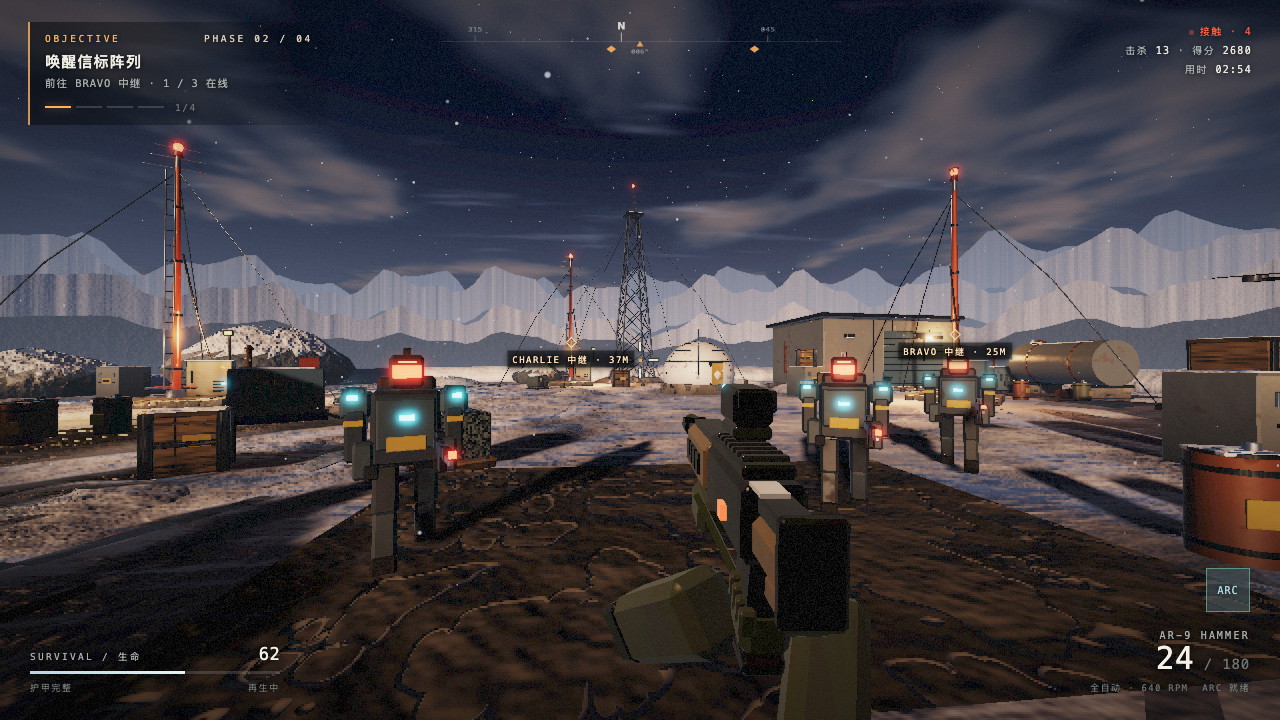
IRONSIGHT passed 6/6 and was still thin. It was green on shaders, census, collision, lights, playtest and look — 0.87 against its reference profile — but had one enemy, one weapon, no settings, no save, no touch, and a title card that leaked the HUD. That produced the product gate: shell and content breadth before look. The next generation, Black Ice, is 318 KB, 8/8, four enemy roles, a boss and a 6–10 minute run.
The prompt appeared at 3m; the action worked at 1.8m. A player at 2.5m pressed E and nothing happened. The UI was lying, and no screenshot could show it. Playtest now checks both directions: the key appears whenever something is in range, and never when nothing is; marker range, prompt text and action radius come from one constant.
The boss died and the run did not end. The death hook set boss.dead = true before the victory timer was queued. The playtest drove the loop to a win instead of reading the counter. Success needs the same visible consequence as failure.
And the snowcat “exploded” because every at() in the transform stack lacked a matching done(). A pixel-only gate would call the debris a silhouette; census, collision and visible geometry checks exist for that reason.
How to use it
Requirements are light: Node.js 22+, Python 3.10+ with Pillow, and Chrome or Chromium. No npm packages, no build step, no API key.
git clone https://github.com/NorwinYu/photoreal-game.git
cd photoreal-game
python3 -m pip install -r requirements.txt

./install.sh /path/to/workspace/.dsh/skills
node harness/verify.mjs --dir ../my-game --page index.html
With no reference profile, the look gate runs fallback: tone and emptiness only. It will not rank your game against another project's style. For a real look target, capture two or three frames from the same project, calibrate a profile, then run again.
No skill loader? Copy SKILL.md to AGENTS.md; the procedure still works as an instruction file.
What it isn't
It is not a template. It does not guarantee any model can produce a 318 KB FPS, and eight green gates do not prove “fun”. The look gate in fallback mode checks tone and emptiness, not taste; the product gate can prove a shell exists, not that the content is worth playing.
It also isn't FPS-only. The city-kart case moved the same skill to another genre: generic gates transferred, the world contract had to be rewritten. That is the difference between a harness and a checklist.
Conclusion
If I keep one sentence: the skill is not about making the model write better; it is about making the model know whether it has finished. Eight gates turn “it looks done” into observable failure, and failure changes the procedure.
Repository: NorwinYu/photoreal-game · Site: photoreal-game · Cases: shooter / city karts.
Reference / photoreal-game · Black Ice · Sunset District · Sundown Circuit · the four runs in Work. Numbers and failure logs come from the skill repository and each project's acceptance record.