Mistvale Farm is the no-Blender baseline: one prompt, Three.js, every model, texture, weather system and sound generated in code. It proves a model can assemble a complete farm loop.
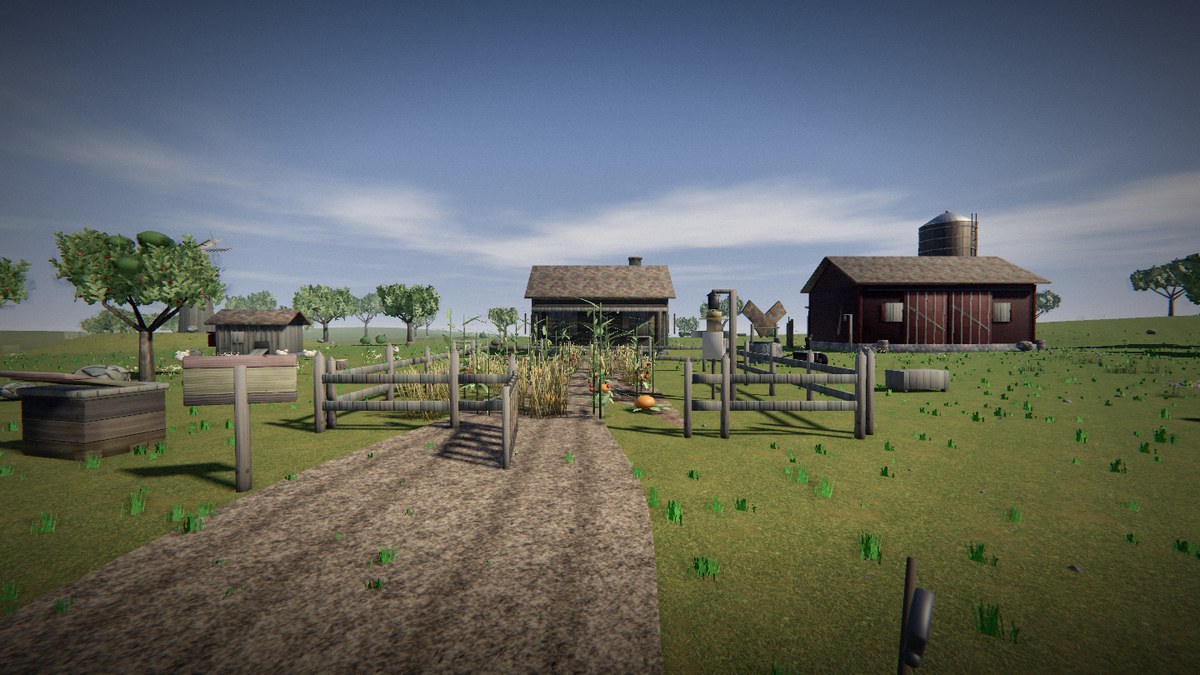
Harvest / 拾穗 takes the same farm concept down another path: assets are generated by local Blender scripts, exported as GLB, then inlined into a single-file game. It proves something different: assets can move from “geometry written in code” to “a reproducible build output”.
Two pipelines
Mistvale's assets are shapes in code: a crate, a tree, a plot, assembled at runtime. Harvest's assets are results in Blender: scripts build faces with bmesh, bevel them, project UVs at world scale, bake AO into vertex colours with Cycles, and export GLB.
Neither uses external images or model files. The difference is where the generation logic lives: one in the browser, one in Blender before packaging.
What Blender does
- Kit: farmhouse, well, fences, shipping box, scarecrow, trees and tools — 39 assets.
- Crops: four crops × four growth stages, generated from one naming and sizing convention.
- Textures: wood, tiles, plaster, bark, stone, dirt, grass, rust, plus six alpha leaf cards.
- AO: each asset is baked separately with Cycles into vertex colour, so objects sit on the ground instead of floating.
- UV: projected by world coordinates; each material has a “metres per tile” value, so a 0.5m crate and an 8m house share texture density.
A browser could generate each of these too, but every size or material change would require re-deriving the geometry relationships. Blender turns those relationships into a rerunnable script and a checkable intermediate.
The cost
The pipeline is not free. It adds a Blender build step, a Python asset layer and a GLB packaging/inlining stage. Source textures are 27.7MB and compress to 2.97MB, but the game file is still around 11MB — much larger than a pure-code demo.
It is also harder to change casually: one model change means editing a script, rerunning Blender, re-exporting and repackaging. The more assets, the longer the chain.
What it buys
- Repeatability: the same script produces the same asset structure and dimensions; no per-run improvisation.
- Inspectability: AO, UVs and material tiling can be checked inside Blender before the game runs.
- Asset density: 39 props, 16 crop stages, nine surface families and six leaf cards can cover a scene systematically.
- Scale consistency: an 8×6m farmhouse, 1.25m fence posts, 1m plots and 1.68m eye height enter the asset, not scattered code.
So Blender acts more like an asset compiler: script and parameters in, GLB and textures out. It is not “better modelling”; it is asset production becoming a repeatable pipeline.
What it doesn't prove
This is not a controlled art comparison. The two builds have different scenes, times of day, asset targets and build budgets; Mistvale's title screen is dusk, Harvest's hero image is daylight. They sit together to show pipeline differences, not to crown a winner.
It also does not prove code-only is worse. Mistvale remains lighter, faster to change and easier to ship. Harvest buys asset density and repeatability, not superiority.
Conclusion
If I keep one sentence: Blender's value is not hand-modelling, but turning assets into reproducible intermediate outputs. It lets 39 props, 16 crop stages and nine surface families be generated, checked and reused in one pipeline.
That is why I want to keep using it: not because Blender is prettier, but because it gives “change an asset” an engineering landing point.
Reference / Mistvale Farm · Harvest · Harvest source · the comparison in Work · photoreal-game skill. Numbers come from Harvest's README and build record; this is not a controlled art review.