NEON BREACH answered “can it be written at all”: five waves, a three-phase boss, a pure API loop, no skill, no product gate. It proved a model could generate a playable shooter. It did not prove the result could be shipped.
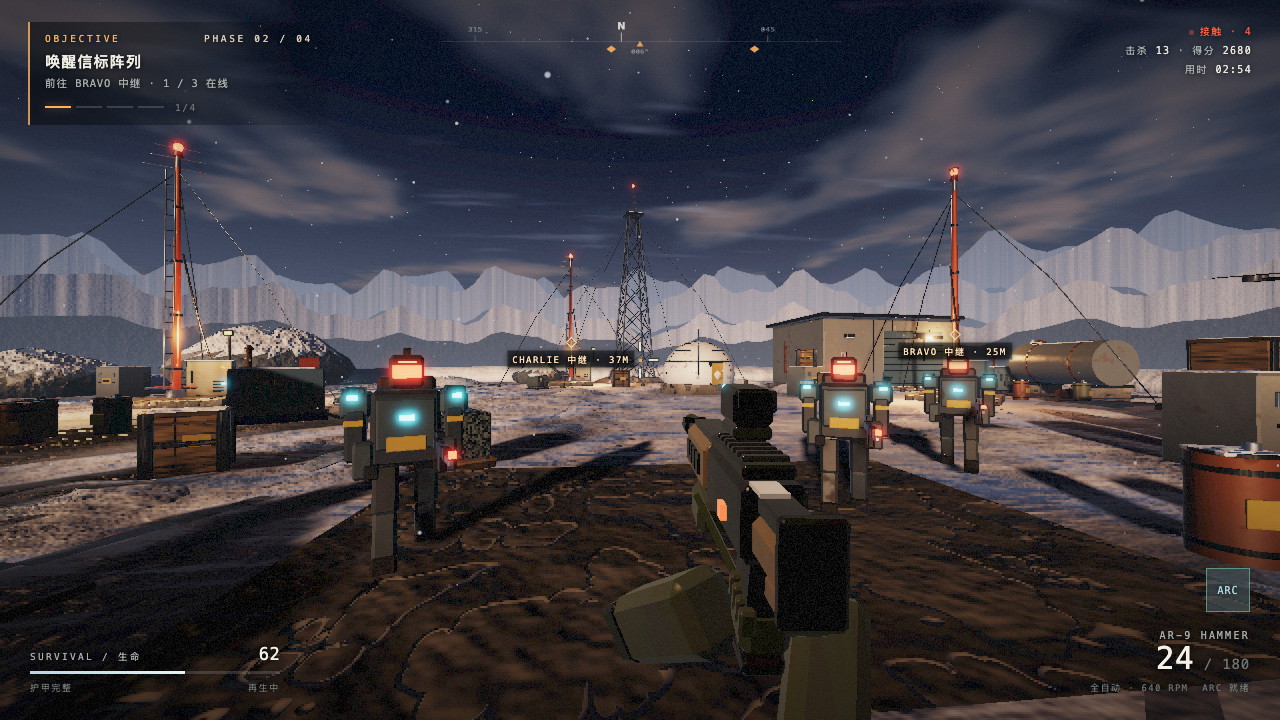
BLACK ICE is the second half of the question. It is still a single-file browser FPS with zero external assets, but it passed an explicit acceptance run: 8/8 gates, 163 draw calls, 127k triangles, 12 lights, 318 KB.
Two entry points
Neon starts with “make it exist”. It has no settings screen, no save, no touch layout, no quality tiers; it has a complete combat loop but not a complete game shell. As a no-skill control, that is useful: it shows where a plain model loop stops.
Black Ice starts with “define what done means”. Title, settings, pause, failure, results, relay objectives, four enemy roles, a boss, touch, audio, performance and mobile checks. It is not Neon plus UI. It is a build that began with rejection criteria.
What 8/8 means
The harness is not a longer prompt. It is six core checks plus two product checks:
- Shader: no shader compile/link failure, no uncaught runtime exception.
- Object census: meshes, instances and near props have identity; nothing hides by being unlisted.
- Collision: the collision contract uses the same movement code the player uses.
- Lights: every light has a physical anchor; no floating light for a screenshot.
- Loop: start, objective, failure and restart close; not just one good frame.
- Look: checked from fixed cameras and exposure; not a lucky screenshot.
- Product / mobile: settings, pause, persistence, touch, objective chain, HUD and performance budgets.
These checks are unglamorous, even boring. They sit exactly between “the demo looks finished” and “the game can be played”.
The countable part
Black Ice's numbers are small: 318 KB, 163 draw calls, 127k triangles, 12 lights. The size is not a compression trick; there are no asset files. Geometry, materials, audio and UI are generated in code. Small is a consequence of content existing as functions.
But small is not simple. It has four enemy roles, three relay objectives, a boss, full movement/aim/reload/interact, touch controls and a 6–10 minute run. Few assets; plenty of loop.
What the harness caught
- No shell: without settings, pause, results and restart, a player cannot really begin or end a run.
- No input closure: desktop working does not mean touch works; touch needs its own layout and state.
- No physical contract: visually grounded is not collision-grounded; players, planes and karts clip.
- No performance budget: a screenshot can look fine while the frame rate is unplayable.
- No observability: if the agent cannot see its output, it is guessing at acceptance.
A gate is not a style prompt. It is a rule that can reject you.
What it doesn't prove
It does not prove 318 KB is a commercial FPS. This is a 6–10 minute single-player vertical slice: no long progression, narrative density or network. It also does not prove the harness replaces taste. A gate can check presence, not quality.
And it does not prove “skill always beats no skill”. Neon is still a complete no-skill control. What it lacks is the product layer, not model capability. The pair exists to show which part the harness adds.
Conclusion
If I take one thing from Black Ice, it is the order of acceptance: define done before writing content; make the gate able to say no before asking the model for more. 318 KB is a nice result, but the eight gates are what make it hold.
Reference / Black Ice online · source · Neon Breach control · the four runs in Work · photoreal-game skill. Numbers come from Black Ice's acceptance record; this is an engineering review, not a product review.