The same city was built twice. First, one model faced an empty directory and, starting from "make a GTA-like 3D city game", worked detail by detail until it walked, drove, sailed, flew a drone, entered seven shops, climbed a tower and caught the last ferry. Then another model took that code and rewrote it into something else.
Both runs left records. This note asks one question: where exactly did the gap happen.
Two sessions
Session one took more than two days and 44 rounds of detail work, and was stopped by one report: "nothing moves when I open it".
Session two has a different hand: Fable 5.2 opened it, Opus 5.5 closed it. It did not start from nothing — its first line was "copy the project, then keep optimising, especially the modelling quality, plenty of logic bugs, game complexity".
So this is not two models each building once. It is a relay: the second one inherited a complete build. That is what makes the comparison fair — same subject, same starting point, same eight gates, a different author.
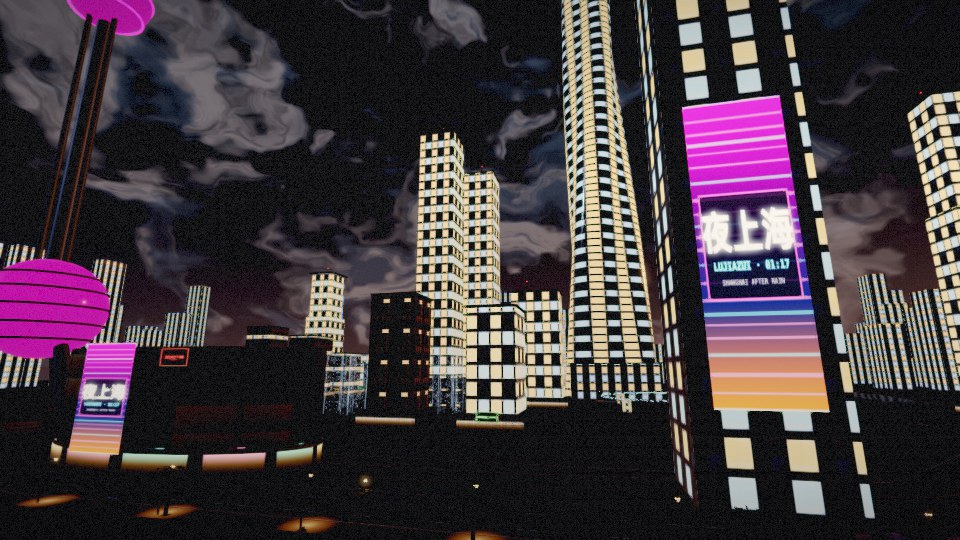
By the numbers
Start with what can be counted, because the argument below depends on it:
| Session one · DeepSeek | Session two · Fable 5.2 / Opus 5.5 | |
|---|---|---|
| Human instructions | 25 | 24 |
| Session span | 51.5 hours | about 29 hours |
| Code produced | 13 files · 9,272 lines | 27 files · 14,934 lines |
| Game layer | one 2,762-line closure | five files, 4,495 lines |
| Single-file size | 2.03 MB | 2.55 MB |
The striking part is that the first and last rows hold at once: the same number of human sentences, half again the output, twice the structure, in less elapsed time. If the gap were in the prompt, that pattern should not appear. The two briefs are near-identical, and the second one's opener is shorter: "copy it, then optimise".
Session one: six phases
Sort the 25 instructions by order and clear phases appear. Every quote below is verbatim; exact clock times are dropped.
| Phase | What the human said | What the phase built |
|---|---|---|
| Opening | "A GTA-like 3D city game… detail first, breadth later" | Skeleton: single file, three.js, city, car, pedestrians, postcards |
| Minutes later | "Don't copy GTA's crime; driving, rides, walking, and tourist tasks" | The crime loop becomes a tourism loop |
| Same stretch | "Can you place the buildings for real from open map data?" | Overpass, then a rebuild on real OSM roads, buildings and shoreline |
| That afternoon | "The buildings are still crude… the car's acceleration and steering are bad" | Car rebuilt (greenhouse, arches, rims, seams), people, tower setbacks |
| That evening | "The road is still not detailed enough" / "the mirror reflection looks fake" | Kerbs, lane paint, crossings, manholes, tactile paving, signals; rough wet asphalt |
| That night | "Coming out of the plaza there's a waterfront platform… does yours match?" | 52-building Bund row, shopfronts, awnings, the far-bank district |
| Later that night | "Clipping… the ferry terminal is blocked… nothing on the river" | Clipping fixed, ferry corridor cleared, 48 → 110 pedestrians, 6 boats, drone pad |
| Next day | "Most objects are still crude cuboids, nothing photoreal" | Rounded car bodies, capsule people, clustered trees, entrances and awnings |
| Next evening | "This bridge does not match reality at all, check it" | 375 steps: Nanpu, Yangpu and Lupu bridges rebuilt; taxi narration added |
| Following morning | "Should we drop the countdown? It would be freer" | Countdown removed, free roam, HUD becomes ∞ |
| Before wrapping | "I just found that nothing moves when I open it" | One misspelled variable threw every frame; fixed, back to 8/8 |
Look at the shape of those sentences. Not one says "make it more premium". Every one says "this part is wrong". The model could fix the point that was named; it could not name the next point itself.
What each round changed
A few rounds in detail, because the distance between "crude" and "detailed" is exactly what those 44 rounds were made of.
The OSM round. The model queried Overpass, failed, switched mirrors, queried again, then reprojected building outlines, roads and shoreline into real coordinates and moved the landmarks from hand-placed positions to their OSM positions. The output was not a prettier frame but a new coordinate system for the whole project: every car, pedestrian, taxi route and minimap afterwards hung off the real road graph.
The "fake reflection" round. It did not dim the mirror. It turned the road into wet asphalt: Fresnel edge falloff, blur, vertical streaks, ripples, a wet-patch mask. That barely shows in a thumbnail, and it is the difference between a rainy night and a shiny floor.
The Bund rounds. The human used the real walk as the reference: out of the ring footbridge, along the promenade, and the far bank should be a wall of stone facades. The model built one row; the human pointed out that the whole opposite bank is buildings too. The next round added the district behind the row, plus physical signage and cordons at the map boundary.
The density rounds. "Not enough stuff on the street" turned into 277 steps: parked cars, shared bikes, pedestrians with bags, vans, a food cart, street furniture — one pass at a time, each followed by the gates and a screenshot.
The bridge round. The first bridges were judged "not remotely real"; the next pass was 375 steps: look up the actual structures of Nanpu, Yangpu and Lupu, rebuild H-shaped pylons, double cable planes and the arch, and add taxi narration along the way.
Eight gates, always green
The project carried a six-plus-two gate harness: shaders, object census, collision, lights, loop, look, plus product and mobile. Almost every wrap-up in the session reads 8/8 PASS.
Yet the human, in the same hours, was saying "crude", "fake", "does not match". That is not a contradiction, it is two rulers: the gates measure thresholds, the human measures likeness. Eight gates can answer "is there a shader error, is collision consistent, are draw calls within budget". They cannot answer "does this building look like Shanghai".
What the model did when it hit a budget is more interesting. As the scene grew, draw calls overflowed:
| Point in the build | Actual calls | Response |
|---|---|---|
| Bund row + Puxi district + promenade + drone | 1,236 | Raise the declared budget from 1,000 to 1,300 |
| 52 Bund facades with shopfronts and awnings | 1,780 | Raise the budget from 1,600 to 1,900 |
It said so itself, in the reply: "This is raising the budget, not optimising." That sentence carries more information than any 8/8. The model knew what it was doing; it took the easier path.
The frozen line
At the end of session one, the human opened the page and found the picture there but the player and the car frozen. The cause was one line:
if (S.mode === 'foot' && C.cafeSeat.active)—C.cafeSeatdoes not exist; it should beS.cafeSeat.
That line threw a TypeError every frame, which killed the whole game loop. Nothing to do with taste, nothing to do with architecture: one missing letter. After the fix the page went from one error per frame to zero, and the gates went back to 8/8.
It belongs in the record because it marks the real boundary of this pipeline: 293 screenshots, 44 self-review rounds and eight gates did not replace a human opening the page and walking two steps.
Session two: after the swap
It opened by copying the project, then did something session one never did: it tried to run modelling as four parallel lines — vehicles and people; city and roads; landmarks and bridges; waterfront and interiors. None of the four finished, and what they left behind did not fit together.
The response is the most interesting part of this comparison. It did not keep pushing in parallel, and it did not call the half-finished work done. It said so plainly — "all four tasks were cut off… so I cannot claim it is bug-free" — and then replanned itself: no more subcontracting, serial stages, each one gated before the next.
Then three things happened.
One: structure first. Session one's 30-game.js was a single 2,762-line closure holding state, clock, movement, driving, interiors, camera, map and handbook. Early in session two it was split into five files: core, motion, interiors, camera and HUD, main loop. That step produces no new pixels, but without it the later systems do not fit.
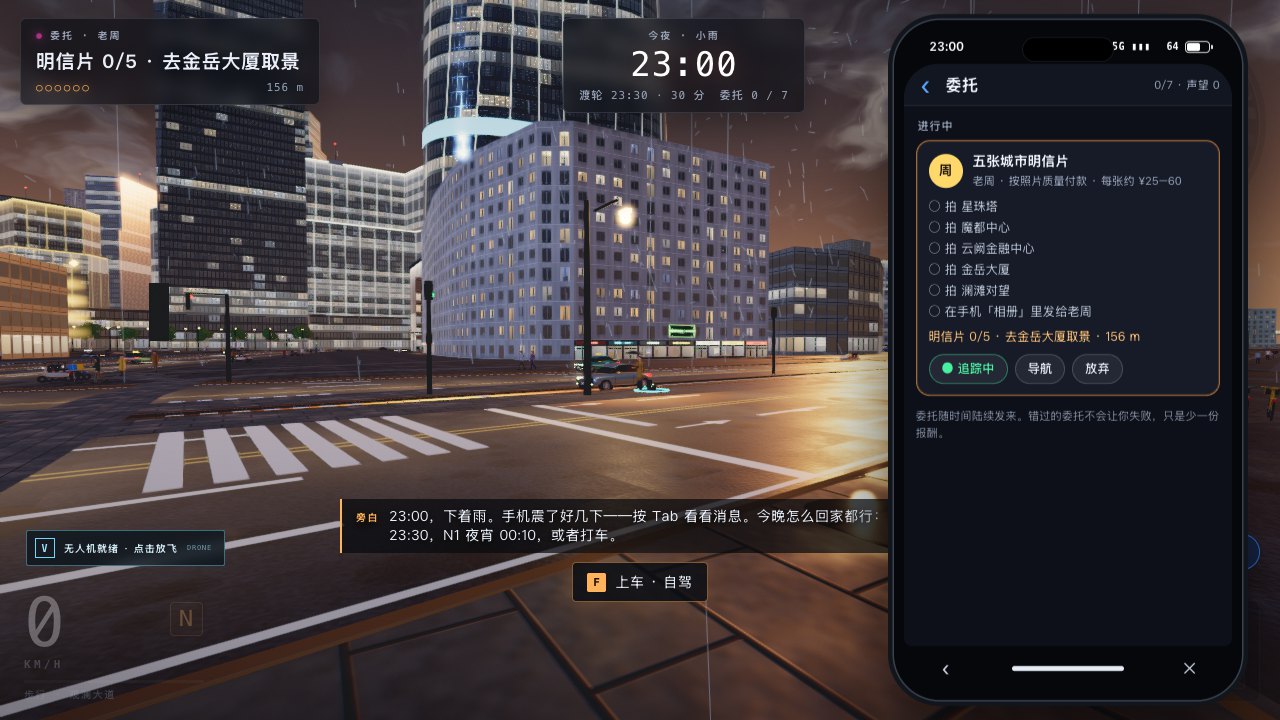
Two: one sentence became a layer. The instruction was: "I'm wondering whether there could be a simulated phone, so the map, navigation and tasks all live inside it. Re-examine the current game state, correct the strategy, the first screen, and the name." No specification. What came back: eight apps (messages, errands, map, taxi, album, wallet, journal, timetable), a phone battery with in-shop charging, seven errands pushed over time, four ways home each with S/A/B/C scoring, a new first screen, a new name, and a handbook and README rewritten to match.
Three: it closes its own loop. It draws the verification boundary itself: which paths were actually exercised, which were only half-checked (mouse lock in a real browser, the mobile layout on a real phone), rather than treating "the script ran" as "this is verified". That is not a victory lap; it is a boundary written into the hand-off.
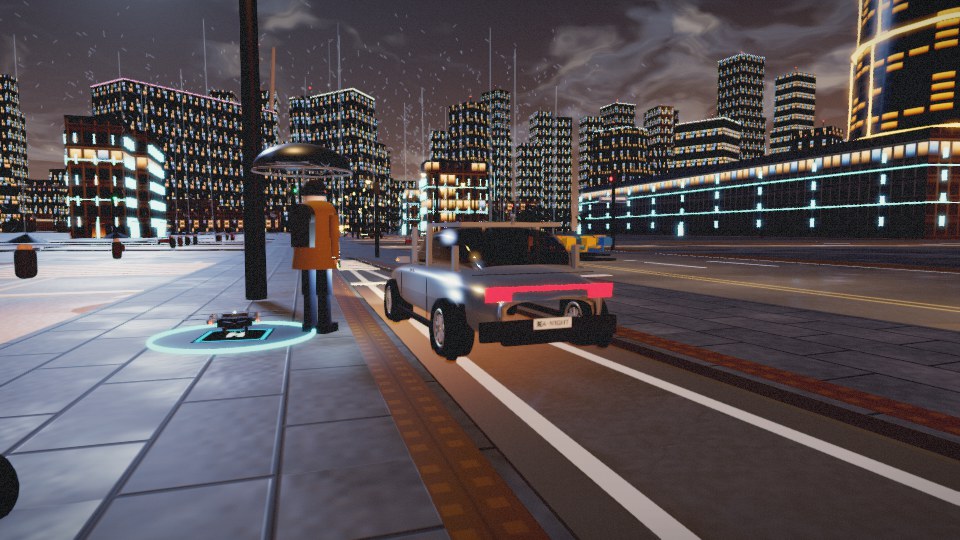
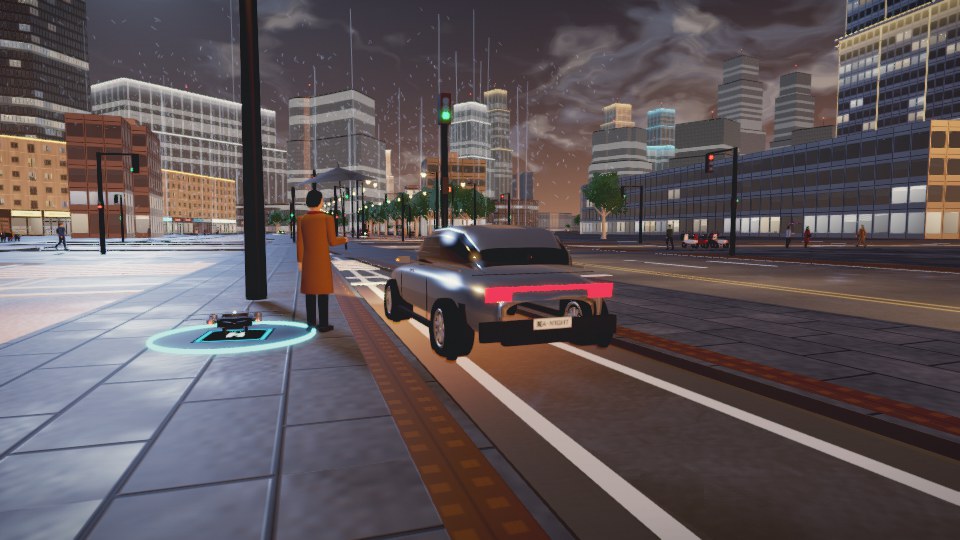
Same camera preset, same city, same street. The difference is not one asset; it is several things landing together. Facades gained tiers and setbacks, so windows stopped being a uniform grid. The car went from hard-edged box to surfaces with arches. Shadows and fog pushed the distance back. The road stopped being glitter and became wet asphalt with roughness.
Where the prompt is
"Why was the second build so much better" is easy to answer with "the prompt got better". With both records side by side, that answer does not hold.
Session two had 24 human instructions, nearly the same as session one's 25. The shape is the same too — short complaints: "the gameplay is too thin now", "can the bridges sit where they belong", "why are there still buildings in the middle of the river", "the taxi takes too long to arrive", "pedestrians walk through walls". The longest message in the whole session is the one asking for the phone — and it is not a spec, it is an idea.
What changed is how much one instruction could move. The same sentence — "add a simulated phone" — would, in session one, most likely have returned a panel that opens and closes. In session two it returned a state machine that re-meshed map, navigation, errands, album, wallet, battery and endings into one loop.
Four capabilities account for that:
- Finding the problem yourself. Every session-one round began after a human named what looked wrong. Session two still needed the human to speak, but it first audited the build itself and listed "the strategy is still the timed sprint", "the first screen has errors", "the HUD needs 11 keys" before touching anything.
- Holding the system at once. That one phone request pulled in rules, first screen, naming, handbook and README; making it coherent in one pass requires the whole project in view.
- Structural sense. Splitting into five files produces no new pixels, but it decides whether an eighth system fits.
- Judging likeness. The hardest one. Session one could pass eight gates and still fail the eye; session two got closer on the same street.
But session two was not "right first time". It tried parallel subcontracting, failed, and replanned itself; what it returned still carried an explicit list of what had not been tested; and the defect that mattered at the end was still found by a human opening the page. Swapping models lowers the cost of building the system correctly; it does not remove the cost of deciding what should be built.
Conclusion
What this measured is not "which model can write code". Both can. It measured feedback bandwidth: how much coherent change one sentence can buy.
Session one spent 25 instructions, 44 self-review rounds, 293 screenshots and more than two days to arrive at a city that plays, where every detail still had to be pointed at by a person. Session two spent 24 instructions and a tenth of the actual working hours to arrive at the same city plus its own schedule, errands, endings and phone.
And those eight gates were green in both. They proved a lot — no shader errors, consistent collision, every light anchored — and they never once proved "good-looking". Which leaves a plain conclusion:
The gates can judge whether something is there. Only a person judges whether it looks right. The model does not think it is ugly; the human does.
That holds for both sessions. The difference is only that in the second one, each sentence the human said moved a much larger block.
Reference / Modu Night Walk online · source · case on Work · photoreal-game skill. Numbers come from the records of both hands and the two source trees. This is an engineering post-mortem, not a product review.