On the evening of November 6 I had an agent generate a Ming palace from a one-sentence Chinese prompt: single file, native WebGL2, an angle you can drag with the mouse. It ran the Maya-XS quantisation of DeepSeek-V4.1-Flash-1017 — about 1.6 bits per expert, 93 GB, tensor-parallel across two 22GB cards and 94 GB of RAM at 131K context. A week later, on November 13, the original model produced another build from the same brief, and that is the one online now.
So this is not a comparison of two models; it is one checkpoint in two sets of weights, an aggressive quantisation against the original. Both work, both are a few tens of KB, both depend on no external files. Put them side by side and you can see the budget went to completely different places — one bought atmosphere, one bought structure.
Two runs
| Item | Local build (quantised) | Online build (original) |
|---|---|---|
| Weights | Maya-XS · ~1.6 bits per expert · 93 GB | Original |
| Hardware | 2 × RTX 2080 Ti 22GB + 94 GB RAM · TP=2 | Not recorded |
| Context | 131,072 | Not recorded |
| Sampling | temp 1.0 · top_p 1.0 · reasoning high | Not recorded |
| Date | 2026-11-06 | 2026-11-13 |
| Output | Single-file HTML · 91,195 B | Single-file HTML · 85,402 B |
| Lines / functions | 2,333 lines · 41 functions | 2,317 lines · 53 functions |
| Draw calls | 3 | 5 |
| Offscreen rendering | None | 1 framebuffer |
The local build
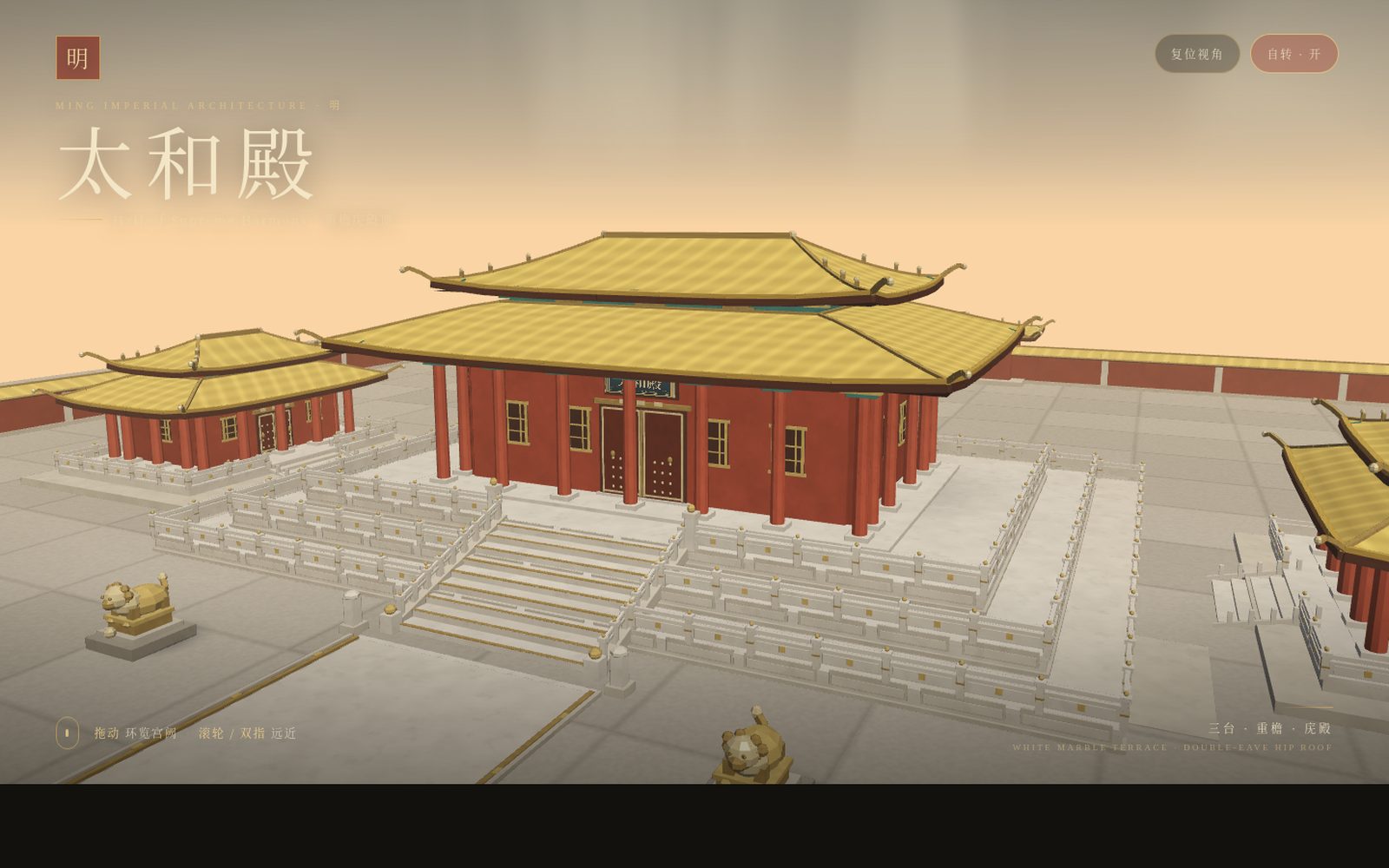
It chose the light between dusk and dawn: an orange sky, warm gold roofs, a white stone base with a little warm bounce, the whole frame pushed dark, a vignette in the corners. The composition is not a straight elevation but an oblique view in perspective, one side hall kept to the left and the right, bronze lions crouched in the foreground, the courtyard paved in square bricks.
The interface is two buttons (reset view, auto-rotate) and one line of hint text. It gives you no camera presets — it behaves more like a scene, and leaves you to turn it yourself.
The session log shows this run took 129 steps and 15 writes or edits to the same file. The prompt itself was one sentence, plus one extra requirement: “work independently, do not consult other files or online material”.
Worth holding on to how small the weights were: Maya-XS keeps about 1.6 bits per expert, 93 GB in total, which only fits with two 22GB cards plus 94 GB of RAM. Decode ran around 25 tok/s. This is not a demo-scale model; it is one of the largest things this hardware can run.
That build is online too, with nothing changed in the file: the local build. Drag it side by side with the newer one.
The online build
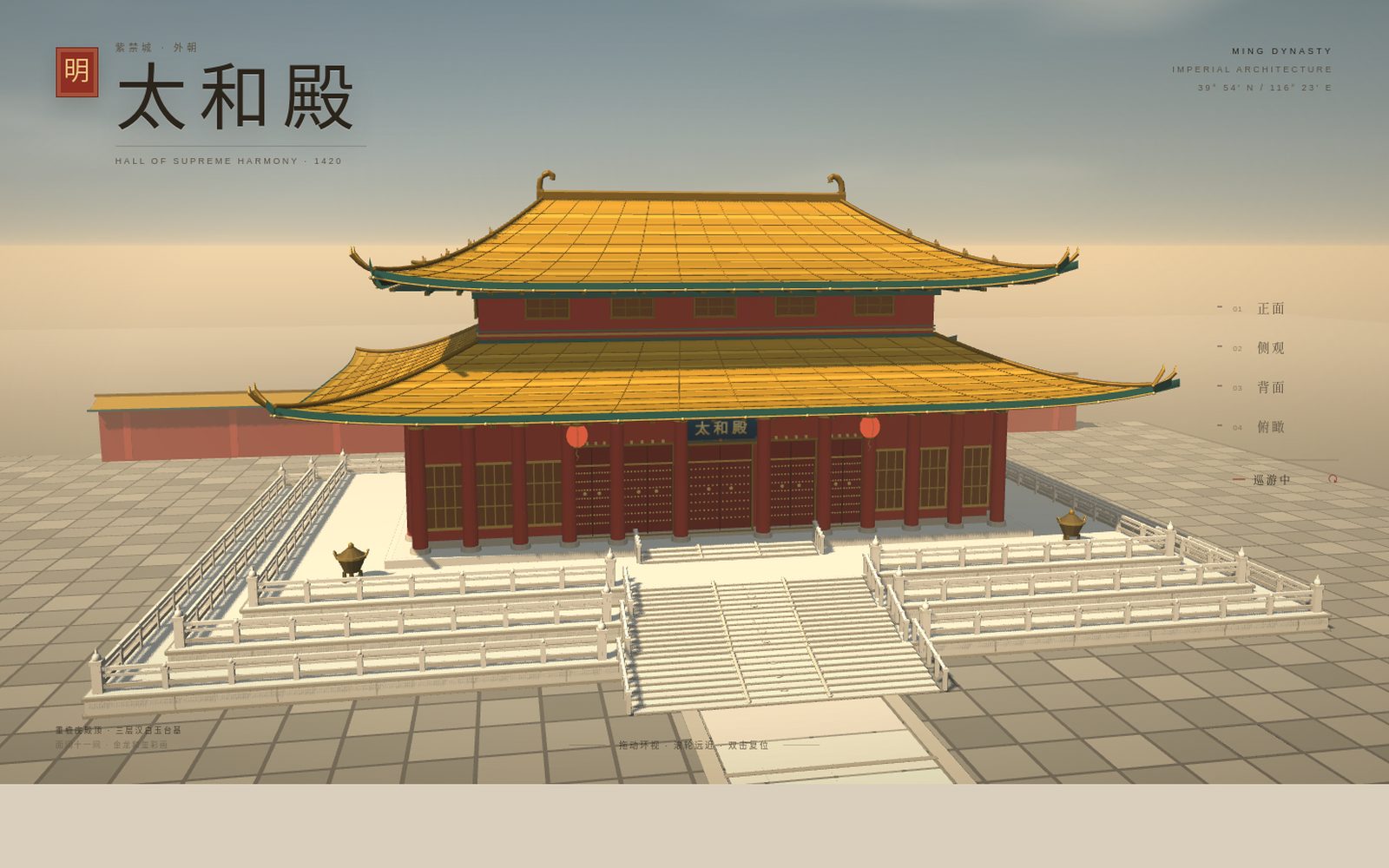
This one goes the other way: a bright hazy sky, a centred straight-on elevation, the layering of the double-eaved hip roof pushed to the front, and the beasts on the ridge, the bracket sets under the eaves and the position of the plaque all more considered than in the local build. The side halls are gone, the foreground swaps to two bronze tripods, and the white stone balustrades line up section by section.
The interface changed approach as well: four view presets on the right (front, side, back, top), latitude and longitude in the top left corner, and one line along the bottom: “drag to orbit · scroll to zoom · double-click to reset”. It is closer to a drawing of a building you can turn than to a courtyard at dusk.
The countable part
Both builds are hand-written WebGL2, no three.js or anything like it. These are the differences you can actually count:
- the local build: 41 functions, 3 draw calls, 1 texture, 0 offscreen buffers;
- the online build: 53 functions, 5 draw calls, 2 textures, 1 framebuffer;
- 91,195 bytes local, 85,402 bytes online, with almost the same line count (2,333 / 2,317).
The framebuffer entry deserves a paragraph of its own: offscreen rendering is what makes post-processing possible — fog, tone mapping, or drawing the scene into a texture first and compositing afterwards. The online build's sky and sense of air most likely come from there; the local build spent the budget on more geometry instead (side halls, lions, courtyard) and finished in 3 draw calls.
Same amount of code: one spent it on more model, the other on better compositing.
This is not a controlled comparison
I have to be clear about this: it is not an A/B test.
- the weights differ (quantised vs original) — which is the variable under study, but the sampling settings were not aligned;
- only the local prompt is confirmed word for word; the online build is recorded on this site as nothing more than “a one-sentence Chinese prompt”;
- a week apart, and the toolchain, the scaffolding and the agent presets may all have changed in between;
- no shared scoring rubric — whether it looks good depends on which one you wanted.
So the only thing I can say is this: at 1.6 bits per expert the task did not collapse — it still got from a single sentence to an interactive single-file scene, it just spent the budget elsewhere.
What I take from it
If the goal is “one screenshot that can serve as a cover image”, the quantised build's warm light still holds up; if the goal is “a building that can be explained”, the original's view presets and double-eave detail are more useful. That difference cannot be attributed to quantisation alone — the sampling and the prompt were not aligned either.
What actually surprised me was not the quality but the size: both sit around 90 KB, both zero assets, zero dependencies. The model did not save the palace as a model file; it wrote the palace as a program — and the run that wrote it had about 1.6 bits per expert.
Method / The local build comes from an archived session on 2026-11-06 (provider maya, model deepseek-v4.1-flash, pack DeepSeek-V4.1-Flash-1017-GGUF/Maya-XS, 131,072 context, TP=2), output a single-file HTML; the online build is deepseek-flash-1017-ming-palace (repository created 2026-11-13). Function counts, draw calls, and texture and framebuffer counts come from a static search over both HTML files, not a runtime profile; the screenshots are each build's first screen at 1440×900.