Journal / 202621 notes
Updated / 2026.11Workbench
notes.
Research, systems and design notes from the workbench. Write long when the question earns it; write short while the answer is still moving.
No content calendar, no growth tricks. Only the questions that were still there after the build.
Writing note: every note here is AI-drafted; projects, data and facts come from me and are reviewed.
A fingerprint
in the noise.
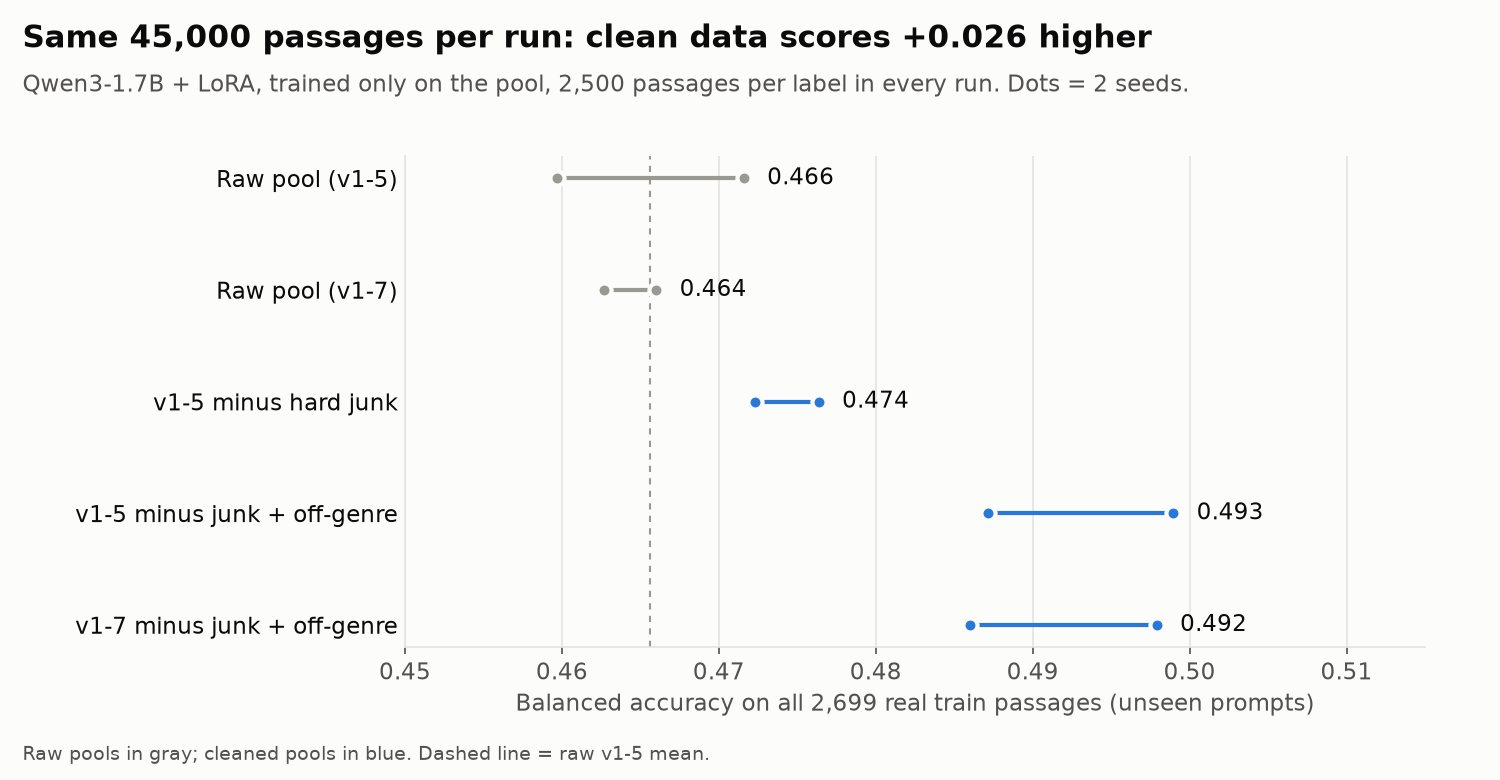
Telling language models apart with a small classifier, and why clean data is more useful than a bigger model.
All notes
20 notesTwenty-five sentences, two hands
Two sessions, almost the same number of human instructions: 44 rounds of defect reports on one side, a system rewrite on the other. What each round changed, where the eight gates stayed green while the street looked wrong, and where the gap actually sits.
20A third of the cost, seven dead ends
Measuring an engineering agent: a hard budget cuts cost to a third with no score change, rewritten project documents lift the partial score, and seven self-check ideas all fail.
19Turning a novel into evidence
chinese-novel-to-game is an extraction project, not a game generator: verbatim evidence, merge rules, a knowledge ledger, and gates that can be rerun.
18One skill, eight gates
What Photoreal Game Harness is: a procedure, eight executable gates, and how it turns a demo into a finished 3D game.
17The same harness, a second genre
From a 3D shooter to city karts: what transfers, what has to be rewritten.
16Blender is an asset compiler
Mistvale and Harvest: one farm concept, two asset pipelines, and what Blender buys.
15Eight gates, 318 KB
Black Ice and Neon: how one harness turns “it runs” into “it ships”.
14Two Taihe Halls
One brief, two generations: a local Maya build and the online DeepSeek Flash 1017 one.
13The exam as evaluation
Two 8-question runs scored 67 and 84: the eval framework's job is to admit the sample is too small.
12Three minutes per restart
Changing a config means loading 55GB: experiment orchestration, the optimizations the second card throws away, and idle NVLink.
1180 and 46
The same 27B model, 80 tok/s in the docs and 46 measured: the power wall and the compute density of MTP.
104% per frame
A zero-subprocess Rust hardware monitor: layered sampling cuts GPU collection from 97ms to 15ms.
09Parallel is not a split
A 20B video model on two 22GB cards: 1.31× to 2.97×, with the host thread as the blocker, not the link.
081,500 steps later
A scale post-mortem on the Three Kingdoms tactics game: where selection, map, auto-battle and phone controls broke first.
07Recognition is only a draft
RoomTessera: the hard part of image-to-3D isn't recognition, it's letting the user correct it.
06An engine is not a bigger canvas
Godot + DSH for an airport tycoon: longer feedback chains, planes clipping through, airport flow and desktop distribution.
05Agent loops need taste
More tools don't make a stronger agent. What's scarce is a loop that knows when to stop.
04The last mile is taste
A generative interface gets you to the first draft; that last 10% still runs on editing, judgment and taste.
03The 44GB VRAM problem
What two 22GB 2080 Ti cards can and can't do, and where local inference actually bottlenecks.
02What 1.4MB actually buys
Unpacking Saltline: zero assets, a model-written content pipeline, and the difference between a “scene script” and a generator.